Are External Regulators Universal, Can You Use Them On ANY Alternator?
Transcript is auto-generated.
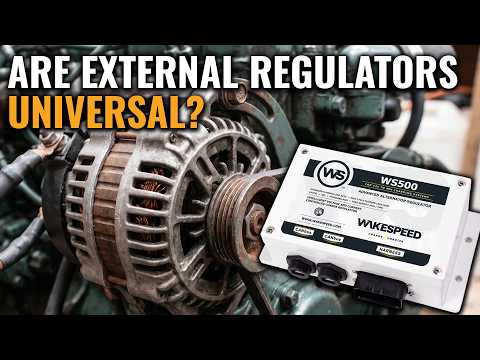
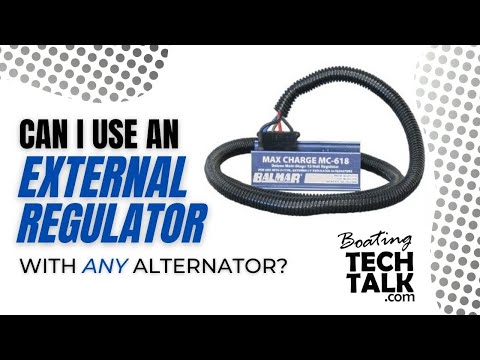
Wanting to get the benefits of an external regulator for your boat and not sure if your alternator is compatible? Check out this video to find out more. We have a big announcement. You can now become a YouTube member. You can join as a YouTube member right now here on screen for custom loyalty badges [music] and emojis. Or, if you are looking for exclusive early access to our videos, live Q&As, and more direct [music] support on your project, we also launched our brand new Patreon page linked in the description below. Thank you so much for [music] watching and being part of the Pacific Yacht Systems community. Now, let's get back to the video. Hi everyone, Jeff Cote here with Pacific Yacht System and we've got another installment of Tech Talk. This time we've got a question from Sylvie in France. She watched one of our videos recently about external regulators and I was talking about also installing a temperature sensor on an alternator. She's got a Yanmar engine with a stock 125 amp alternator and she's wondering if she can do an external regulator on her boat. And the answer is, in short, yes. Now, is it plug and play? No, but you can have any existing alternator modified for external field. So, all alternators, and this could be in cars, in boats, in heavy machinery, have what are called internal regulators, which regulate the output voltage of the alternator and they do that cautiously and safely, but also underperform the full potential of the alternator. So, the goal with an external regulator is outputting what is more than an internal regulator, but not so much as to overburden or kill your alternator prematurely. So, it's a fine line and a really, really good external regulator, like for example, the Wake Speed would be a really good choice. Balmar makes some, too, but, you know, the Wake Speed now has way more features and is way more user-friendly, so I would definitely recommend that model. I used to have the Balmar, but the Wake Speed, if you're willing and you're more willing to geek out, is probably a better choice. So, back to Sylvie's question. So, what you would end up doing is she's got a 105 25 amp alternator. I would bring that alter Take the alternator off the boat, bring it to an alternator shop, and then you would literally ask the alternator shop to remove the external the internal regulator, and to give you a wire for field voltage. The field voltage is really the way that you drive the alternator. So, when you apply a voltage to that wire, it actually goes from zero output to max output. You would install an external regulator, which we have whole videos on, and it's pretty time-consuming to do. It's not an easy thing, but definitely worth doing. And if you're a do-it-yourself, you can do it, but you need to educate first before doing. The Wake Speed would have a temp sensor probably for the battery, and a wipe sensor also for the alternator, and you could definitely install the temp sensor on the alternator, and then you could also have that 125 amp alternator give you probably a 50% boost on its output because, like I said, an internal regulator is overly cautious, and you can probably gain eight It's not that you're going to go from a 125 to 200 amp alternator, but right now she's probably realistically Sylvie's probably getting only about half of that alternator in terms of output. Uh so, she might be getting 40, 50, 55 amps out of it. And if she puts an external regulator, she might be getting maybe 80 or 90 amps from that alternator. Remember, the alternator is 125 amp at cold rated and 125 amps at maximum output. So, you'll never really see 125 amps cuz you're not running your engine at full output, or you shouldn't, and the alternator's in stay cold for a long time. So, those numbers are sort of like comparison numbers, but it's not actually the true output that Sylvie's going to see on her Yanmar engine. So, yes, you can, to Sylvie's question, have pretty much any alternator modified to external field, and you can then install a external regulator to get more output from your alternator so that you can recharge your house battery bank faster. And as a sailor, that's great because most of us don't want to motor sail or motor for longer than we need to. And if we can get away with sailing sooner, it's better. And for cruisers of power boaters, a lot of us have large battery banks. And again, if we can get to our destination with our batteries full as fast as possible, the best way to do that is with a high output alternator connected to an external regulator. So, great question from Sylvie, and the answer is yes, totally doable. If you've got further questions on external regulator, we have a whole section on our website on the how-to section. I invite you to check that out. The link is in the description below. If you're thinking of tackling an external regulator and you're in our service area, uh reach out to Pacific Yacht Systems. Uh we'd be sure to glad to help out. If you're thinking of doing this as a do-it-yourself, you can support this channel by purchasing an external regulator at rotonmarine.com. [music] Check out the links in the description below. And thanks so much for watching, and take care, and be safe on the water. Hey fellow boaters, we're going to be doing a lot more tech talk [music] videos. If you've got any suggestions for future videos, leave them in the comments below. Once again, thank you for watching.