Your Alternator is OVERHEATING Because of Your Lithium Batteries! | PYS TECH TALK
Transcript is auto-generated.
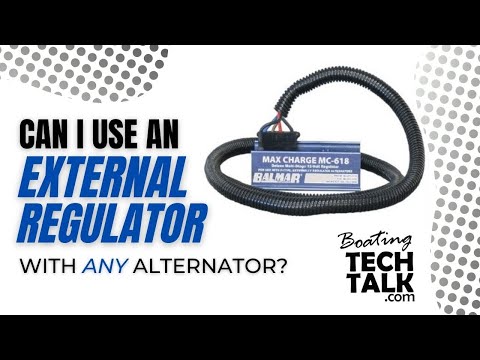
How do I make sure that my alternator doesn't overheat and die prematurely because my lithium batteries are just so hungry for charge? >> [music] >> Whether you need a remote consultation design or perhaps inviting us aboard your boat, Pacific Yacht Systems is here to help. Check out the links in the description below. Hi everyone, Jeff Cote here with Pacific Yacht Systems. We've got a question from a fellow boater, Jim. Jim asks, "Want to recharge our battery banks with our alternators. Why did my alternator heat up?" Jim has a good question. Goes back to this whole concept of drop-in replacement for lithium batteries. Unfortunately, there's no such thing as really a drop-in replacement for most of us. It might happen on a few and those are the stories that obviously some manufacturers want us to believe, but the reality is that when you drop in lithium batteries in your boat, your batteries really have this unsatiable appetite to take as much charge as you can probably throw at them. And it doesn't matter how big your alternator is, it might be, you know, 120 amps, 200 amps, 300 amps at 12 volts. Realistically, the battery bank is going to be easily be going to take it and it's going to take it for a long time. So, unlike lead-acid batteries, either flooded or AGM, at one point the alternator sort of like with the regulator with throttle back. And yeah, it's possible for sure to overheat uh an alternator with a big large uh lead-acid battery bank, but with lithium, it's probable. Not just likely, like it's most likely going to happen. So, what you need to worry about uh and what Jim is asking is how do you make sure that that doesn't happen again? So, first of all, you probably want to consider an external regulator, something like WakeSpeed, which is what I have on my boat, or Balmar, which I used to have on my boat. They have their place and really depends what you're looking for. And so, this external regulator is a device that controls the charge output of your alternator. And it also is customizable and one of the profiles you can say, you know, for a lithium charge profile. So, you can actually give the battery what it needs. But also, what's really useful with an external regulator is you can actually have a temp sensor mounted on the chassis of the alternator. So, in the event that your alternator is overheating, either because it's running for a long time or the ambient temperature in the engine room, which is hot to begin with when the engine is running, is getting too hot, it's actually going to throttle back and uh either stop or reduce your charging output on your alternator. Might be annoying because now your alternator is not outputting as much as you'd like, but the alternative, blowing up your alternator, isn't good either. So, an external regulator is going to be able to use the temperature at that is sensed on the alternator to actually regulate the charge output of the alternator. Furthermore, and what I recommend as well, is you might not want to ask yourself, does it make sense to ask my alternator to be outputting its full capacity for an extended period of time? On my boat, I chose not to do that. I chose to de-rate my alternator by about 25%. And so, my alternator, instead of running its maximum output for a duration of time, is always running at a maximum of 75% of its maximum output. Now, why would I do that? Well, the harder you run an alternator, the hotter it gets. And so, what I'm looking for, it's really a balance between having a fast charge rate, which would be a high output, and running like running a car at, you know, maximum RPM, 6,000 RPM. It's fastest speed. You can do it, but does it make sense to do so? So, what I've decided on my boat and some boats is we actually de-rate the alternator to a level where we're going to find that's probably going to be a good sort of balance between output and longevity on the alternator. So, if you've installed lithium battery bank on your boat and you haven't considered your alternator, you should. Ask yourself, how do I make sure that my alternator doesn't overheat and die prematurely because my lithium batteries are just so hungry for charge. And you do that with an external regulator by potentially derating your alternator output and also by installing a temperature sensor on your alternator. Great question from Jim. A real problem with lithium, not unsolvable. There is a solution, but hope is rarely the answer. If you've got any further questions, check out the links in the description below. And also, thanks for watching and don't forget to subscribe and like this video. [music] It helps us grow the channel. Hey fellow boaters, we're going to be doing a lot more Tech Talk videos. And if you've got any suggestions for future videos, leave them in the comments below. Once again, thank you for watching.