How to Wire Multiple Marine Solar Controllers to One Battery Bank
Transcript is auto-generated.
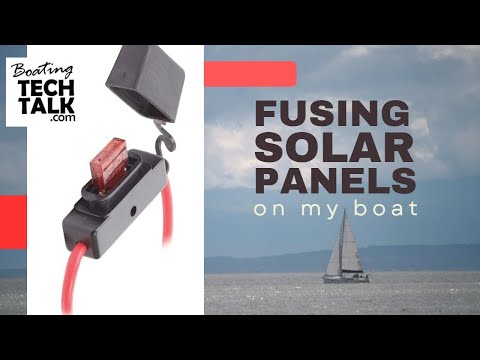
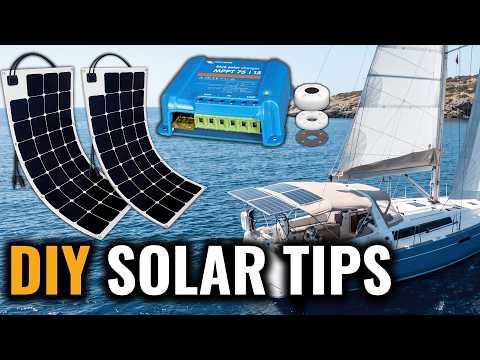
Connecting two solar controllers back to a single battery? Check out this video to find out the right wire size and fuse for your setup. We have a big announcement. You can now become a YouTube member. You can join as a YouTube member right now here on screen for custom loyalty badges and emojis. Or if you are looking for exclusive early access to our videos, live Q&A's, and more direct support on your project, we also launched our brand new Patreon page [music] linked in the description below. Thank you so much for watching and being part of the Pacific Yacht Systems [music] community. Now, let's get back to the video. Everyone, Jeff Cote here with Pacific Yacht Systems and we've got another installment of Tech Talk. We've got a question from a sail boater uh named Scott from Washington state. Scott's got a problem. He's doing a solar project and he's installing uh two controllers that can't be really installed it close to the battery bank. And instead of running two pairs of wires from the controllers all the way to the battery bank, he'd like to run only a single pair. His question is how does he go about doing that and what's the proper way of fusing those two solar controllers? By the way, this is not an uncommon issue and Scott's right to wondering about how to do it right, but it's not going to be that hard. So, with two controllers, it probably a fuse block in the back doesn't make sense, but what you'd want to do is you'd want to have probably a little bit of a distribution block where you would uh have each controller positive going to a common post on a distribution block and each of those controllers would have a dedicated fuse. So, for instance, perhaps a 15 amp fuse or a 10 amp fuse depending on what size controller you're installing. And you'd have a 5 amp, 10 amp, or 15 amp fuse from that distribution block to the controller. And then you'd run So, in effect, you'd have two reds and two negatives going to that distribution block. And then from that distribution block, you'd run a larger gauge wire that would run the aggregate. So, for example, if you had two 15-amp uh circuits connected to that distribution block, which could be a gauge 14 wire, right? Rated uh 15-amp, 14 gauge is no problem. Two 15-amp circuits is a total of 30 amps. A 30-amp circuit is now going to be a gauge 10. And so, then you would run a gauge 10 pair of wires from that distribution block all the way to the unswitched distribution at the battery. Now, at the battery, right? Or the unswitched distribution, the always-on connection, you'd put a 30-amp fuse. So, in total, you'd have two 15-amp fuses close to the controllers connected to that distribution block, and then you'd have a 30-amp fuse connected at the unswitched side. On my boat, I actually have four controllers. So, this is where scaling then maybe changes a little bit your options. So, on my boat, at the back of my boat, what I end up putting is a small little blue uh Blue Sea's fuse block that has six circuits. Two of them are on use. So, these four solar controllers go to this fuse block, and then this fuse block is powered over a larger gauge wire all the way back to my unswitched distribution. So, you can scale that, and some of us are going to find ourselves with six controllers maybe at the after the boat, three, four. At one point, it might make sense to install a fuse block as opposed to installing inline fuses, right? Cuz it's cleaner, easier to manage, and you're not having all these fuses that might give you grief. Obviously, fuse blocks are always better than inline fuses, just for management and seeing the status of the fuse and knowing. So, good question. Uh pretty straightforward to do. To recap, you just want to make sure that the aggregate wiring that goes from the two controllers to the battery or the three controllers or four or six can handle the overall total amperage from all controllers. So, make sure that the wire and the fuse can handle the aggregate loads, not loads or charging current that you're going to see from those solar controllers. Great question. If you're more curious about solar for your boat, check out the description. We've got lots of videos and guides on how to do solar for your boat. And if you're tackling solar here locally, check out our website or installation and service. We're always more than glad to help to tackle this project on your behalf. Thanks for watching and be safe on the water. >> Hey fellow boaters, [music] we're going to be doing a lot more tech talk videos. If you've got any suggestions for future videos, leave them in the comments below. Once again, thank you for watching.