DON'T MAKE THESE MISTAKES When Installing Solar Yourself!
Transcript is auto-generated.
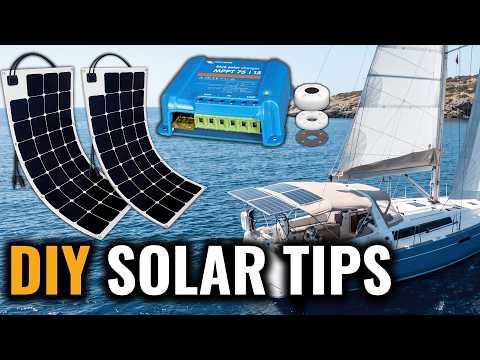
Just bought some solar panels online, not knowing what to do. Check out this video to find out the gotchas in doing a solar install for your boat. We have a big announcement. You can now become a YouTube member. You can join as a YouTube member right now here on screen for custom loyalty badges and emojis. [music] Or if you are looking for exclusive early access to our videos, live Q&As's, and more [music] direct support on your project, we also launched our brand new Patreon page linked in the description below. Thank you so much for [music] watching and being part of the Pacific Yacht Systems community. Now, let's get back to the video. Hey everyone, Jeff Cot here with Pacific Yacht System and we're doing another installment of Tech Talk. We've got a question from Adam. Adam asks, "Jeff, I'm considering buying a solar panel kit and I'm wondering what are the sort of like the gotchas of doing it myself. I've got basic home electrical experience and what advice would you give me?" So, Adam brings up a good question. First of all, for those of you that have not considered solar, maybe you should, especially for some of us who are using our boats and not coming back to a dock at the end of the day. So, if you're a cruiser and you're contemplating using your boat overnight or for extended time, maybe a week, a long weekend, two weeks, or even longer, solar panels are a really good way for you to recharge your battery bank. And it's not just a feel-good purchase. It's actually going to give you tangible benefits. I've talked in other videos about the formula for what you need in sizing solar panels and you can geek out and check out in the links below uh more information about that, but I'm going to stick to Adam's question here. So, let's assume, and I do agree with Adam, it's it's worthy to consider doing solar in your boat. What are the pros and cons of considering doing it? So, when you're installing solar in your boat, well, first of all, you're going to have to consider where you're going to mount it. So, that's something you've got to have sort of figured out because there's a geometry place. So, you're going to have to make sure that your panels are sized to fit where you're going to mount them. So, you can't just buy solar panels and then figure out where you mount them. It's more the other way around. You got to figure out what space you have available either, you know, um, on your dodger, on your bimin, on a hard top, either canvas, fiberglass. You got to figure out what size solar panels are going to fit and how are you going to mount them. Are you going to mount them with fasteners? Are you going to adhere them? Are you going to do peel and stick? Are you going to use zippers, uh, snaps, velcro? All different methods. And that's something that you as the installer are going to have to figure out. So, that's the first probably real constraint or reality is that mounting solar panels on a boat doesn't just happen. they don't just come into place magically. You're going to have to figure out how you're going to attach or mount those panels to your boat. So, that's something you want to consider. Now, installers that have done this often are going to obviously have more tricks up their sleeve than someone who's not done it. But again, you can do your research, but that's something you want to figure out is like where are you going to where are the panels going to go and how are you going to mount them. This is not trivial. I mean, it's not hard, but like you want to figure it out before you sly just go down the rabbit hole. The next thing is going to be, and this is where it gets a little bit tricky, is how do you route a cable from wherever your panels are mounted back to where your deep cycle batteries are located. So on some boats, it's trivial, but on some other boats, routing a cable that might be 20 ft, you know, 30 feet, like maybe 10 m throughout a boat through bulkheads, you've got to obviously come into the boat, then you've got to route the cable. So that's something that as an installer you need to be comfortable with probably getting on your hands and knees and it's going to be frustrating. So expect that it's going to be frustrating and then you won't be disappointed or heartbroken that your install is not going well. Routing cables on the boat is rarely a fun activity. It's not hard per se. It's just tedious cuz you got to find a way. You might need to have fine pull strings. uh you know you might have to use different sort of tricks uh of the trait to run cables between places where you can't access them. Running the cable is probably besides mounting the panels, running the cable is probably the single hardest part of the job. Not complicated to do, but can be definitely frustrating. When you're running the cable inside your boat, you definitely want to make sure that the cable comes inside your boat and it comes through a weatherproof gland of some sort. So again, you're going to be drilling a hole in your boat. So you want to make sure that you drill it only once. So you've got to make sure that on both sides you've got access. How are you going to route the cable, you know, in through the biminy, through either a dodger, a hard top, if you're putting it on on the deck, well, what's on the other side? You got to consider all these things because it's one thing to drill a hole, but what happens if the cable comes on the other side and now it's visible? Now, some people don't care, which is great for them. Some other people care about aesthetics. So if you care more about aesthetics, you're going to want to make sure that the cables are as hidden as possible. And then it comes back to doing the connections. So, not again, not crazy hard, but the devil's always in the details. So, you're going to mount the solar panel to a controller and then the controller to the battery. Where it gets a little tricky is if you've got a battery monitor, you're not going to be able to connect the solar controller directly to the battery. You're going to have to connect it to the load side of the shunt. If you don't connect it to the load side of the shunt, then you'll never your battery monitor is going to get out of sync. So, that's another gotcha. Uh, again, not hard, but something you need to consider. And then the last bit is obviously fusing. So, you're going to need to fuse for the right size controller that you have and the solar array. And the controller matches the solar array you're going to install. And then you're going to want to program the controller program to the exact battery chemistry that you have on your boat and your battery bank. The location of the fuse and the connection is something you need to consider. Obviously, the easiest conceptual thing is connecting it directly to your battery, and that's easy to consider. But on some of our boats, we're going to not want to do that. We're going to want to bring it to what's called a positive distribution, and it's got to be unswitched. So, you need to make sure that your solar panels are always connected to the battery even when your battery switch is off. So, in a nutshell, that's basically how you install solar panels on your boat. Make sure you size the panels for what's the spaces available. Figure out how you're going to mount them. Figure out the cable run. Make sure that the deck penetration or the penetration on your boat is done once and done properly. Hide the cable as much as possible. Come to the battery and then install the positive and negative at the right place from the controller to your either your battery or positive distribution. The negative should go to your on the load side of the shunt and uh commission the controller. So, some owners for sure are going to be able to tackle that. Some other owners are going to delegate that to installers and some other owners are going to do half and half. So half and half is I've seen owners say, you know, I'm going to run the cable, but I'm going to have an installer come on board and do the commissioning and do the connections. I'll do the hard part of running the cable. That's going to be tedious. And then you can worry about installing the panels and doing the connections of the controllers. So that's sort of the middle of the ground because it really depends on your skill set and your own aptitude with anything on a boat. Of course, I always advise no bravado. You know, make sure that you do what you're comfortable in doing. And if you're not comfortable in doing it, you know, either of course you can easily delegate or you need to educate, right? And that's what you're doing is you're learning here today and trying to make sure you do things right on your boat so that you don't take any shortcuts and make the whole installation of your solar panels worth it for you. So, uh, thanks for watching. If you'd like to help us, uh, grow the channel, uh, we'd appreciate if you could subscribe. Curious for more information, check out the links below. Also, as a reminder, we of course sell these solar kits. Uh, we've got them on our website at rotonarine.com. And the big thing about what we do as well is if you've got questions, uh, we're not a big box store and we can help you along [music] the way as well. So, thanks again for watching. We'll see you in the next one. Hey fellow [music] Boers, we're going to be doing a lot more tech talk videos. If you've got any suggestions for future videos, leave them in the comments below. Once again, thank you for watching.