How to Monitor Lithium Battery State of Charge Without Bluetooth
Transcript is auto-generated.
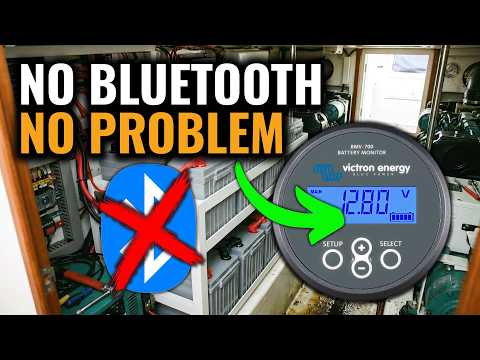
How do you monitor a lithium battery bank without [music] a Bluetooth BMS? Whether you need a remote consultation design or perhaps inviting us aboard your boat, Pacific Yacht Systems is here to help. Check out the links in the description below. Hi everyone. Jeff Cote here from Pacific Yacht Systems with another installment of Tech Talk. We've got a question from Ralph and he's got a Kanner Man 46-ft Bahia. And he asked, "Jeff, I've got a lithium battery bank that's connected to a bus bar and on to that bus bar is also connected a large solar array." And he says, "How do I know the capacity of my batteries considering that the BMS in my batteries don't have Bluetooth and I have no ability of knowing the state of charge for my lithium battery bank." This is a very similar problem that lead-acid battery owners would have aboard boats. The challenge right now for Ralph is the way that his system is configured. He has his lithium batteries connected to the same bus bar as his uh solar. In actuality, they should be separated. So, he needs to find a way to have two bus bars. So, the battery should be connected to a bus bar. The bus bar then in turn is connected to his charging bus bar which could be connected to his solar and everything else that is charging. His battery chargers, all charging devices should be connected to that. The link between his battery So, his battery bus bar and his charging bus bar and that charging bus bar also goes to his loads, he should have a shunt in between. And the reason why they need to be disconnected is you need to be able to measure all the current going in and out of the battery. And the only way to do that is to have a shunt. And the shunt is going to be connected to a battery monitor and the battery monitor is going to be counting all the transactions either going inside the battery via the alternators, via the solar, via the battery chargers, or the draws. Now, it doesn't separate loads from charge, so you only see the net. Right? So, if you've got 100 amps coming out, 80 amps going in, you're going to see only 20 amps going out of the batteries, cuz it's offset by the 80 coming in for the 100 going out. But, it will tell you over time what is the deficit on that battery bank or the charge. Now, of course, it's not as great uh as a boat owner that would have a lithium battery bank where his BMS would be connected, for example, to a screen that would give him literally his state of charge, like some of us have on our boats. So, the way to work that around for Ralph is to have a change a slight change in his setup, separate his battery bank from his charging and loads, put a shunt in on that circuit or in between the two, and then have that connected to a battery monitor. I I think it's important to remember an incredible advantage of lithium and also a slight disadvantage of lithium. Lithium batteries are staying at a constant voltage for pretty much most of the discharge. Like, you'll see a lithium battery start at 13 V 13.4 V, let's say, on a 12 V battery system, and it's going to stay like that for a long time, even as you're discharging the battery. Eventually, it might drop down to 12.9, you know, maybe 12.8, but it's going to stay steady steady for a long time, and then slightly taper off. A lead-acid battery would right away start dropping. So, some boat owners would infer battery capacity from battery voltage, albeit not great, but you would still be able to infer it. With a lithium battery, you can't do that. The voltage stays steady, which is great for running appliances. Like, anything loves higher voltages. Like, generally, and this is another thing to consider, like, if you've got your boat plugged into shore power and your shore power is at 13.4 and your electronics don't shut off, everything runs smoothly, and then you disconnect from shore power, you don't have a battery charger, and your voltage is now 12.3, 12.4, 12.7, and things start like not running, it's because when you're connected to shore power, your battery voltage is higher, so anything lost that you might have, bad connections, a voltage drop, any of that stuff is offset by having a higher charge voltage when you're connected to shore power. When you go to lithium, you have that benefit most of the time because you'll rarely ever see 12.7, if ever, and your voltage is going to stay between 13.4 to maybe 12.9, 12.8 even under load on a lithium battery bank, where a lead acid battery bank, even including AGM, you can see your voltage drop all the way to 10.5 volts, right? So, you've got a much bigger range where things stop working on a lead acid battery bank, where lithium, the voltage is always steady, well, not always, but mostly steady, and that makes things run longer. But, the problem with that is you can't infer capacity from voltage with a lithium battery bank, hence why Ralph is wondering how to do it. And uh that's a valid point. So, certainly, when you're considering buying lithium batteries, take that into consideration, you know, how can I know its capacity? And if you can't, then that's okay, then make sure that you're able to install a battery monitor to capture all the loads going in and out of the battery bank, including also the charges. So, charges and all loads have to be separate from your battery bank. You need a single choke point where you can count all the transactions. It's like having a one door in a house, and you count all transactions of everyone that leaves the house, comes inside the house, and that's what a basically a shunt does. A shunt will count all the the in and out of that battery bank and give you an estimate for the capacity. So, that's how I would do it. Great question from Ralph. Thanks all for watching. Uh please subscribe to the channel if you're new here. If you have and want to further help, please like the video. It helps us a lot with the algorithms and to reach out to fellow boaters. If you've got questions about your boat and are designing a lithium battery bank for your boat, reach out to PYS. We We offer remote consultation and design services. The links are in the description below. And if you're in the Pacific Northwest here [music] and you'd like to have us on board your boat to help out, you know where you can find us and we appreciate [music] the opportunity to be of service. Thanks for watching and safe boating and see you on the water. Hey fellow boaters, we're going to be doing a lot more Tech Talk [music] videos. If you've got any suggestions for future videos, leave them in the comments below. Once again, thank you for watching.